12 August 2026 : Totale, the ‘summer night’ at dusk
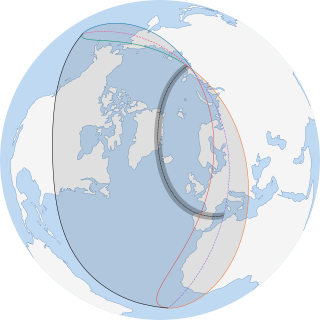
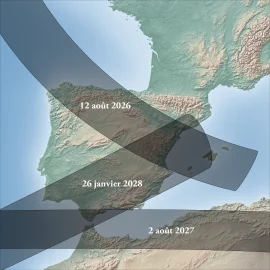
In the middle of summer, the Sun is about to perform a real disappearing act. The band of totality crosses northern Spain (and also passes through Iceland) : there, for about 1 to 2 minutes depending on the location (max 1 min 50 s in northern Spain, up to 2 min 18 s on the central line before reaching Europe), the day changes - the sky turns blue, the air cools, and the solar corona appears as a living halo around a black disc. And it all happens quickly : the shadow moves at about 3,429 km/h, like a dark wave breaking silently. In France, it will be a partial eclipse in the evening, perfect for observing on the way back from the beach or a picnic : the light becomes strange, as if someone had slowly turned down the world’s dimmer switch. And for ‘easily accessible’ Europe, it’s a highly anticipated event : the first eclipse visible from mainland Europe since 1999, the return of a great spectacle close to home.
2 August 2027 : Total, the great ‘long’
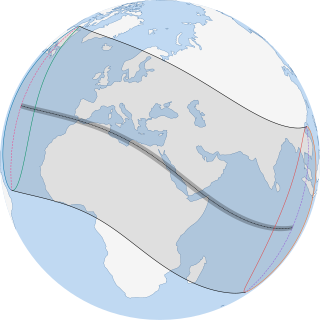
A year later, another dramatic turn of events... but this time in the morning, when the sky is clear and the shadow advances across the continent at a speed of 2,398 km/h. The totality grazes Europe via southern Spain, towards Andalusia and the Strait of Gibraltar : there, the darkness can last several minutes (up to nearly 5 minutes in the best areas : 4 min 49 s in Ceuta, more than 4 min 30 s in Tarifa), long enough to feel the silence descend and see the horizon take on the colours of twilight across 360°. Further along its path (particularly towards Egypt), the eclipse reaches a maximum of around 6 min 23 s – the second longest total eclipse of the 21st century and the longest over easily accessible land, said to leave ‘time to look’, as if time itself were looking : time to be surprised, time to understand, time to get goosebumps. In France, it will be seen as partial, like a crescent nibbling at the Sun, but the event itself will take place a few hours’ drive away. And to exceed this duration, we will have to wait a very long time, nearly a century : the next longest total eclipse is announced for 3 June 2114, with a maximum of 6 min 32 s, before the very long one on 13 June 2132, approaching the maximum duration of a total eclipse when all the optimal celestial conditions are met, i.e. 7 min.
26 January 2028 : Annular eclipse, the “ring of fire” at dusk
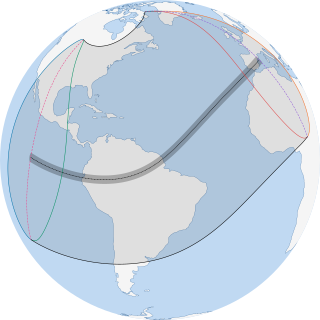
The final act, in the middle of winter : not a night in broad daylight, but a celestial gem. On 26 January, the Moon moves directly in front of the Sun without covering it completely : it leaves a bright, thin, sharp, almost unreal ring – the famous ‘ring of fire’. The ring-shaped band once again passes over Portugal and Spain (with a passage towards Gibraltar and northern Morocco) and, as an added bonus, the phenomenon occurs in the late afternoon : a twilight spectacle, where the ring can last for several minutes, with a global maximum of around 10 minutes, which is very rare for an annular eclipse and therefore exceptional (the maximum ‘theoretical’ duration of an annular eclipse is around 12 min 35 s). Here, the relative slowness of the shadow is part of the magic : nearly 1,709 km/h - and it is also one of the main reasons why the ring can linger for so long. In France, it will be a partial eclipse : a foretaste. But in Iberia, with a clear horizon, we will be able to see the Sun wearing its ring – as if the sky were signalling, in light, the end of this trilogy.
Learn more
Total solar eclipse on 12 August 2026
Total solar eclipse on 8 August 2027
Annular solar eclipse on 26 January 2028
