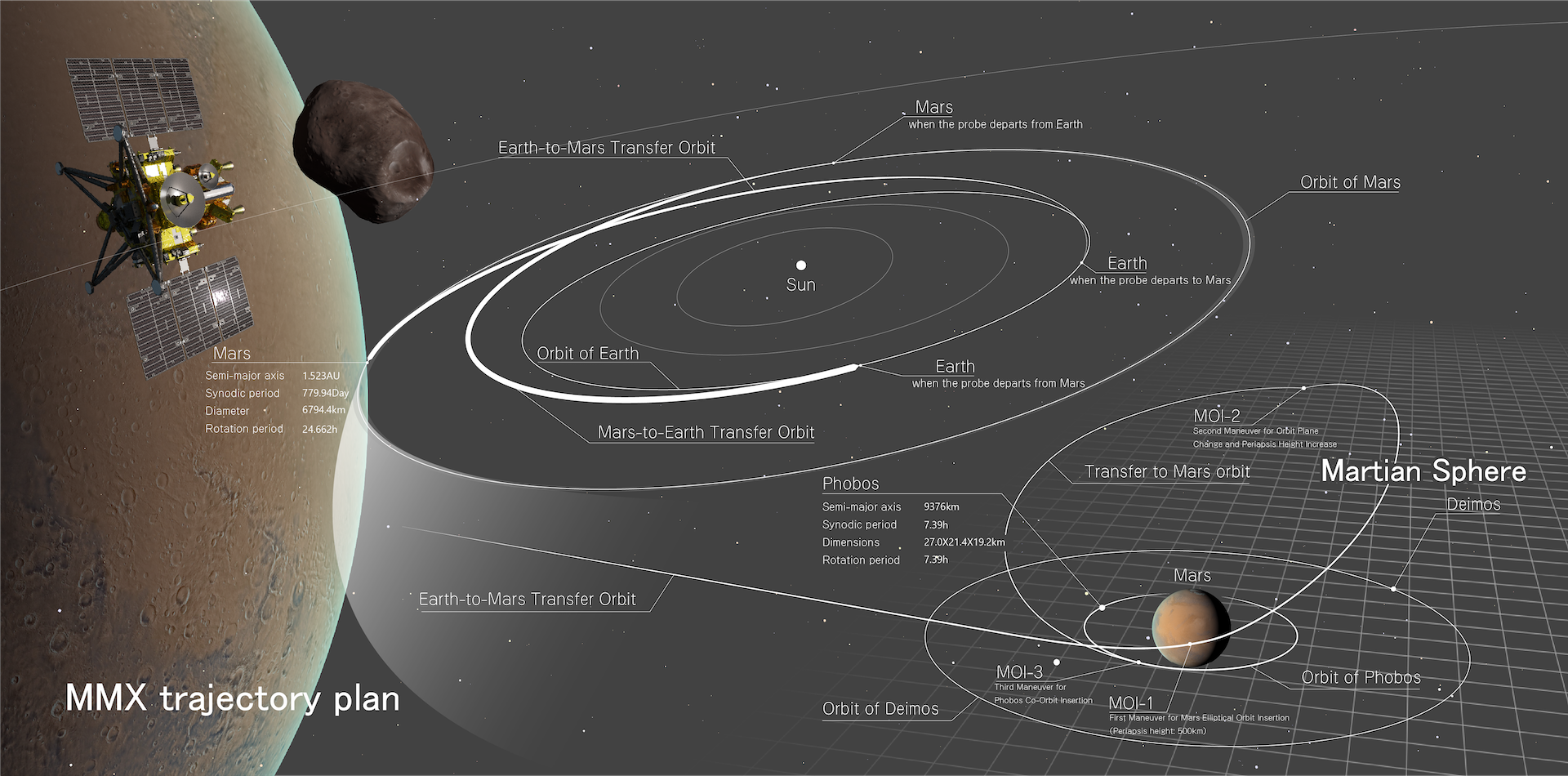
MMX Trajectory plan.Crédits JAXA
While bringing back samples from Mars isn’t yet on the agenda, the MMX probe is getting close. In fact, it’s set to accomplish a remarkable feat : collecting samples from Mars’s moon, Phobos, and returning them to Earth. As a reminder, Mars has two moons, Phobos and Deimos, each with a radius of about 10 kilometers. While these two moons have physical characteristics similar to those of asteroids, their orbit around Mars is, however, not entirely consistent with the theory that they were captured by the planet’s gravity. This has led to questions about their origins that have puzzled the scientific community for several decades.
To shed light on the origin of Phobos, an in-situ analysis of the regolith (rock dust) is not sufficient. It is therefore necessary to conduct laboratory analyses on Earth. This is precisely the primary objective of the MMX probe. In addition to remote analyses of Mars’ moons, MMX will have to land on Phobos to collect samples from its surface, bring them back to Earth, with arrival scheduled for 2031. As if that weren’t enough, the mission will also deploy a small Franco-German rover named Idéfix, after the beloved dog created by René Goscinny and Albert Uderzo in the Asterix comic books. The rover will attempt to explore the surface of Mars’s largest moon.
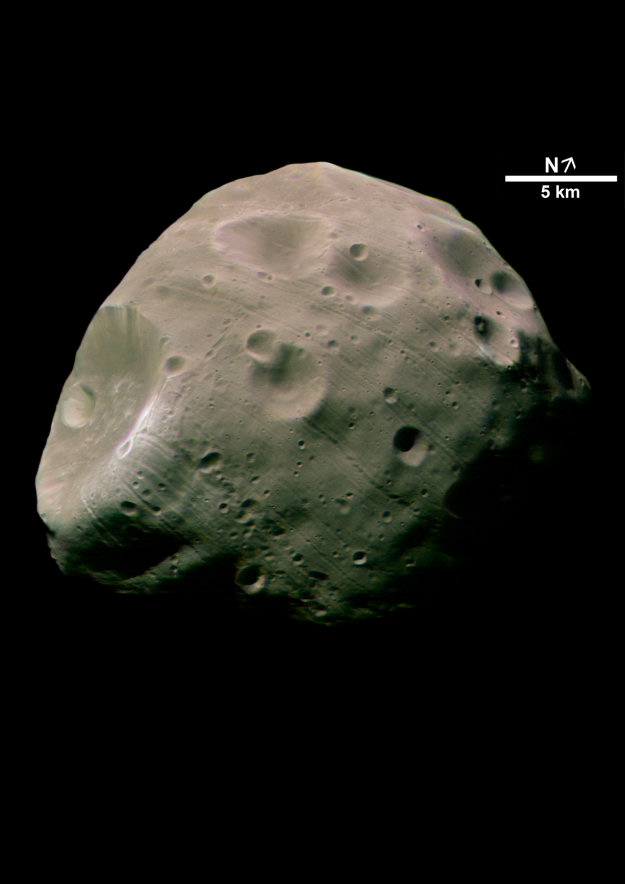
The moon Phobos, as observed by the European Mars Express spacecraft. Crédits ESA/DLR/FU Berlin, CC BY-SA IGO 3.0
As you can imagine, none of this would be possible without precise knowledge of the positions of Mars’s moons. And this is precisely where SE-OP comes in : JAXA has selected the ephemerides for Mars’s moons developed at SE-OP to support the MMX mission. Over the past three years, we have been working closely with the Japanese space agency and the French National Centre for Space Studies (CNES) to provide the most accurate ephemerides possible, helping ensure that MMX can encounter Mars’s moons under optimal conditions. Our ephemerides have also benefited from astrometric data collected by the European Space Agency’s (ESA) Mars Express spacecraft. Remarkably, Mars Express has been orbiting Mars since 2004 and continues to observe the Martian system to this day. In this way, the MMX mission will carry a little piece of Europe (and of SE-OP) all the way to the Martian moons.
En savoir plus :
’The MMX Mission on the JAXA Website’ https://www.mmx.jaxa.jp/en/mission/
’Mars Express on the ESA website’ https://sci.esa.int/web/mars-express/
’Link to the Espace Department of the Paris Observatory’ https://seop.obspm.fr/