
Gravity measurements are a unique tool for subsurface imaging, as they provide direct information on underground mass variations. They also play an essential role in establishing terrestrial spatial references. Gravimetry can be used to map and monitor subsurface dynamics, and has numerous applications : geothermal energy, monitoring climate change, groundwater and volcanoes, and underground gas storage.
After decades of research, development and industrial transfer, quantum technology has reached a high level of maturity and it is now possible to benefit from operational quantum gravimeters in the field, offering numerous advantages over the devices used until now.
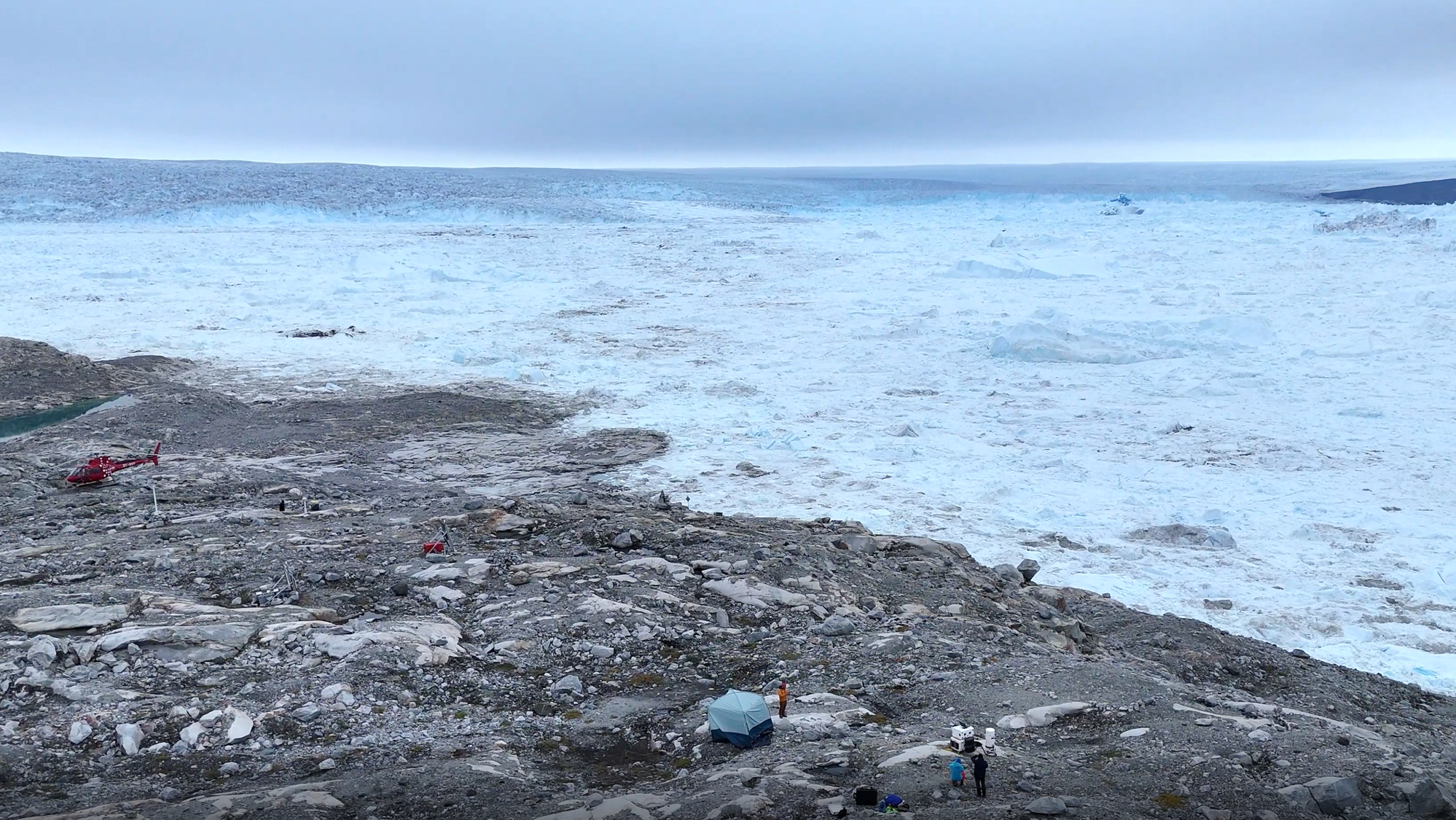
Quantum gravimeter deployed in Greenland in August 2025 as part of the EQUIP-G project.
Credits Tim Jensen, DTU
The EQUIP-G consortium is deploying a fleet of quantum gravimeters across Europe and offering free loans to the geophysical and geodetic community to use this technology. By 2029, the project will provide the European Commission with details and recommendations concerning a future fleet of shared instruments (terrestrial or onboard quantum gravimeters). This will involve managing requests from various public institutions, monitoring the instruments and providing training. Finally, it will also involve finding the best solution for storing and making available all the data, which will be public.
The future entity would be similar to a research infrastructure, with challenges similar to those faced by astronomers who reserve observation time and collect data when sharing telescope time.
How does a gravimeter work ?
A quantum gravimeter is a sensor that replicates Newton’s apple experiment. Several times per second, atoms are trapped and cooled by laser to form a small sample of matter. This test mass is then released in free fall into a vacuum. The acceleration experienced by the atoms is measured by a vertical reference laser using the principle of atomic interferometry, which allows precision measurements to be made by interfering waves of matter manipulated by laser pulses. The result corresponds to the acceleration of Earth’s gravity, g.
The LTE laboratory’s LNE-OP service was one of the pioneers of interferometry worldwide in the early 2000s, and part of this research was successfully transferred to industry in the 2010s. Active research on the subject continues to be conducted by the Atomic Interferometry and Inertial Sensors team.
Who is behind this project ?
Following a call for proposals from the European Commission (HORIZON-CL4-2024-DIGITAL-EMERGING-02), the EQUIP-G project, comprising a consortium of 20 partners from 11 European countries, has been selected to develop and deploy a network of quantum gravimeters in Europe by 2029. The project is led by the CNRS and headed by Sébastien Merlet and Jean Lautier-Gaud, members of the LTE.
Learn more
The project website.
Atomic Interferometry Team Web Page du LTE.
Video, broadcast by ARTE, describing how the quantum instrument works on Mount Etna.
