In the early 19th century, a number of experiments, including those conducted by Thomas Young and Augustin-Jean Fresnel, led to the triumph of the wave theory of light. However, not all scientists were convinced. Siméon Denis Poisson, for instance, a proponent of Isaac Newton’s corpuscular theory of light, was staunchly opposed to it. The controversy intensified with a question put forward by the Academy of Sciences in 1818. On that occasion, Poisson had noted that one of the consequences of Fresnel’s wave theory would be the presence of a bright spot at the centre of the shadow cast by a circular opaque disc, due to constructive interference of the wave. This struck him as absurd : how could light illuminate the centre of a completely black shadow ? Especially since no one had ever observed such a spot… However, François Arago was able to produce one using a small metal disc. The jury members were convinced, and the Academy’s prize was awarded to Fresnel in 1819.
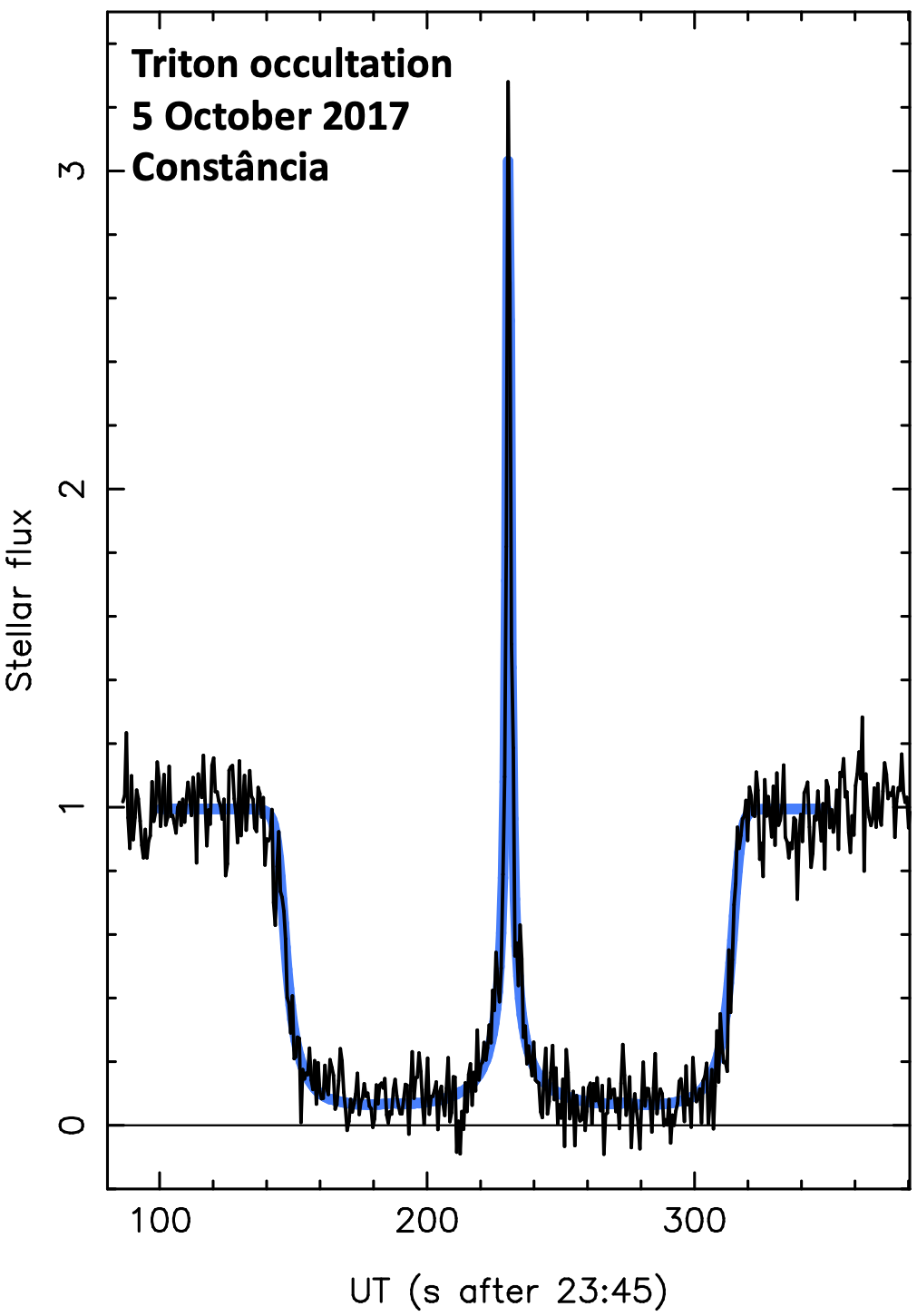
In memory of these debates, the observed spot is now known as the Poisson spot, or the Poisson-Arago spot, or the Fresnel spot. It made an unexpected reappearance during calculations carried out to describe the ‘central flashes’ observed during stellar occultations by objects such as Pluto or Triton (see figure opposite). The question was : what is the structure of the flash produced by a perfectly spherical and transparent atmosphere ? Can its amplitude be infinite ? What role does diffraction play ?
The calculations describing the flash involve path integrals and make use of Sommerfeld’s lemma, which is fundamental to quantum mechanics. This is only logical : photons are, by their very nature, quantum objects ! Building on this, the authors consider several scenarios, starting with a spherical occluder without an atmosphere, of radius R0, and a star assumed to be point-like. This yields the classical Poisson spot, whose maximum irradiance is equal to that received from the star outside the shadow. The Poisson spot is described by the square of the Bessel function of the first kind and zero order, J0. It is an oscillating function that reaches unity at the centre of the shadow and has a width close to λ∆/(2R0), where λ is the observation wavelength and ∆ is the geocentric distance of the occulter. This peak is also surrounded by fringes, equally spaced at approximately λ∆/(2R0).
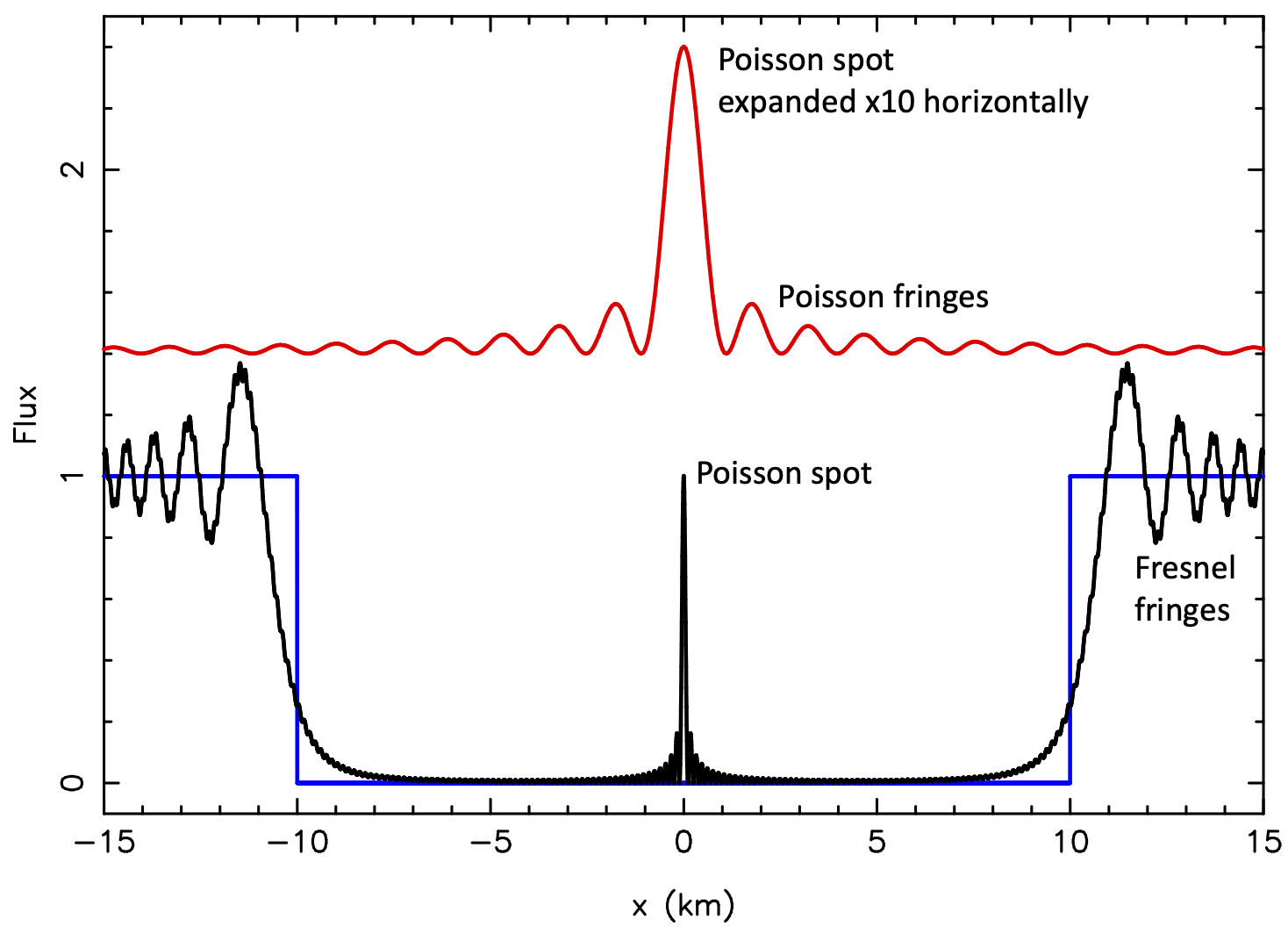
The figure opposite shows the structure of the shadow cast by an opaque spherical body with a radius of 10 km situated at Pluto’s level and observed in the visible spectrum. Note the classic Fresnel fringes on the left and right edges, caused by the object’s abrupt and opaque limb.
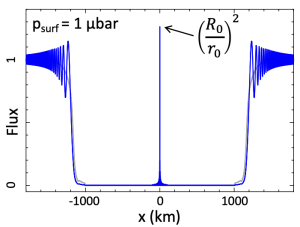
If we introduce a thin atmosphere, but one too weak to focus the light rays towards the centre of the shadow, not only does the Poisson spot remain, but it is amplified by a factor of (R0/r0)2, where r0 < R0 is the radius of the shadow cast by the body, taking into account the refraction of light rays due to the atmosphere of the occulter. The figure below shows the theoretical structure of the shadow of Pluto, whose atmospheric pressure has been arbitrarily reduced to one-tenth of its current value, and observed in millimetre waves. The Fresnel fringes mentioned above can be seen at the edges of the shadow, as well as the central Poisson spot amplified by a factor of (R0/r0)2.
If the atmosphere is dense enough to focus the light rays towards the centre of the shadow, r0 no longer exists. Calculations then show that diffraction imposes a finite flash height of approximately (2π)2RH/(λ∆), where R is the radius of the layer causing the central flash (close to R0), and H is the height scale of the atmosphere. For Pluto and Triton (with 0.01 mbar at the surface), this flash height can reach very large values in the visible spectrum, ranging from 104 à 105 times the star’s luminance outside the occultation. At the same time, the width of the flash projected onto Earth λ∆/(2R) is extremely small, on the order of a metre, making it impossible to resolve with current technology. However, as this width is proportional to λ, observations made at millimetre wavelengths could resolve the flash and the fringes surrounding it, which would then have sizes on the order of a kilometre.
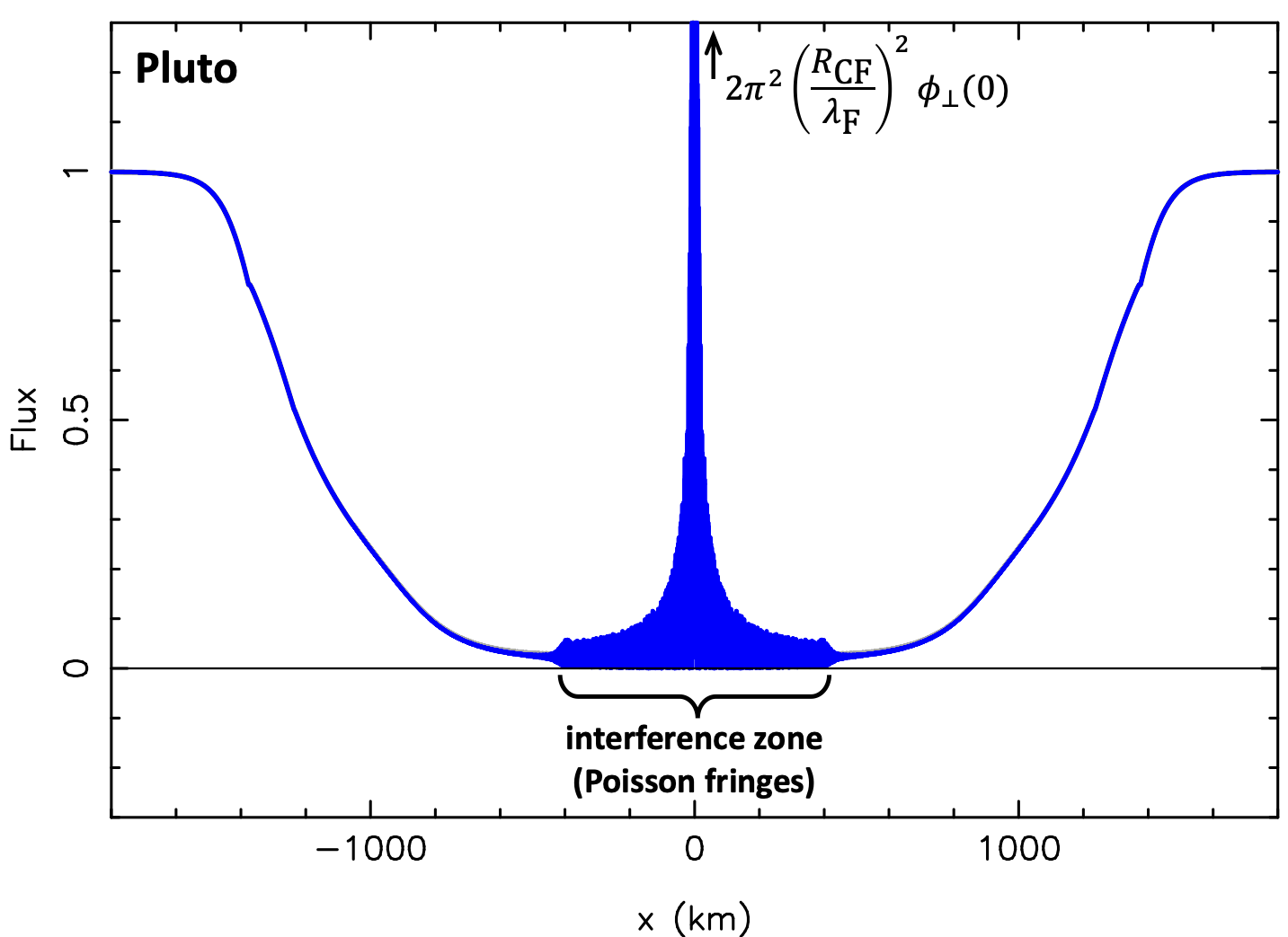
The figure opposite shows a theoretical curve of a Pluto occultation observed in the visible spectrum. The Fresnel fringes are now too faint to be observed. Around the flash, which reaches very high off-scale values (104), rapid fluctuations caused by Poisson fringes can be seen. These fringes result from interference between the primary and secondary stellar images produced by Pluto’s atmosphere, and are therefore identical to the interference produced in Young’s double-slit experiment, but with a subtle additional phase quadrature correlated with the fact that the light rays corresponding to the secondary image pass through the axial caustic just before reaching the observer’s front plane.
That said, other effects must be taken into account when describing the flash. For example, the size of the occulted star is finite. When projected onto the occulting body, this size is usually of the order of one kilometre. This implies that diffraction effects are smoothed out by the stellar diameter : in the case of a thin atmosphere, the height of the central flash is then less than (R0/r0)2 ; in the case of a dense atmosphere such as Pluto’s at present, calculations show that despite this smoothing, the flash can still reach heights more than 50 times the star’s initial signal. Another effect to take into account is the possible distortion of the atmosphere relative to the spherical model. In this case, the Poisson spot is replaced by a caustic lined by fringes, a subject for future study…
Reference
The article is published under the title : “Central flashes during stellar occultations.
Effects of diffraction, interferences, and stellar diameter” on 17 March 2026, https://doi.org/10.1051/0004-6361/202555548
This research is the result of scientific work carried out in France at the Paris Observatory – PSL, in the Laboratoire Temps et Espace (Paris Observatory – PSL / CNRS / Sorbonne University / University of Lille), and at Jean Monnet University in Saint-Étienne, CNRS, in the Institut d’Optique Graduate School, and the Laboratoire Hubert Curien , UMR 5516.
Contacts
Bruno Sicardy
Professor Emeritus SU, LTE
+33 (0) 1 40 51 23 34
bruno.sicardy@observatoiredeparis.psl.eu
Luc Dettwiller
Contributor to Laboratoire Hubert Curien,
Institut d’Optique, Saint-Etienne
dettwiller.luc@gmail.com
