Certain parts of Neptune’s rings show concentrations of material, forming incomplete rings also known as arcs. One such arc was discovered in 1984 using the stellar occultation technique by teams from the Paris Observatory and the University of Tucson in the United States. This discovery paved the way for the flyby of Neptune by NASA’s Voyager 2 mission in 1989.
The probe’s cameras thus revealed a faint ring, known as Adams, within which four dense arcs orbited, named Courage, Liberty, Equality and Fraternity.
Observations have continued from Earth, either using ground-based adaptive optics or from space with the Hubble Space Telescope.
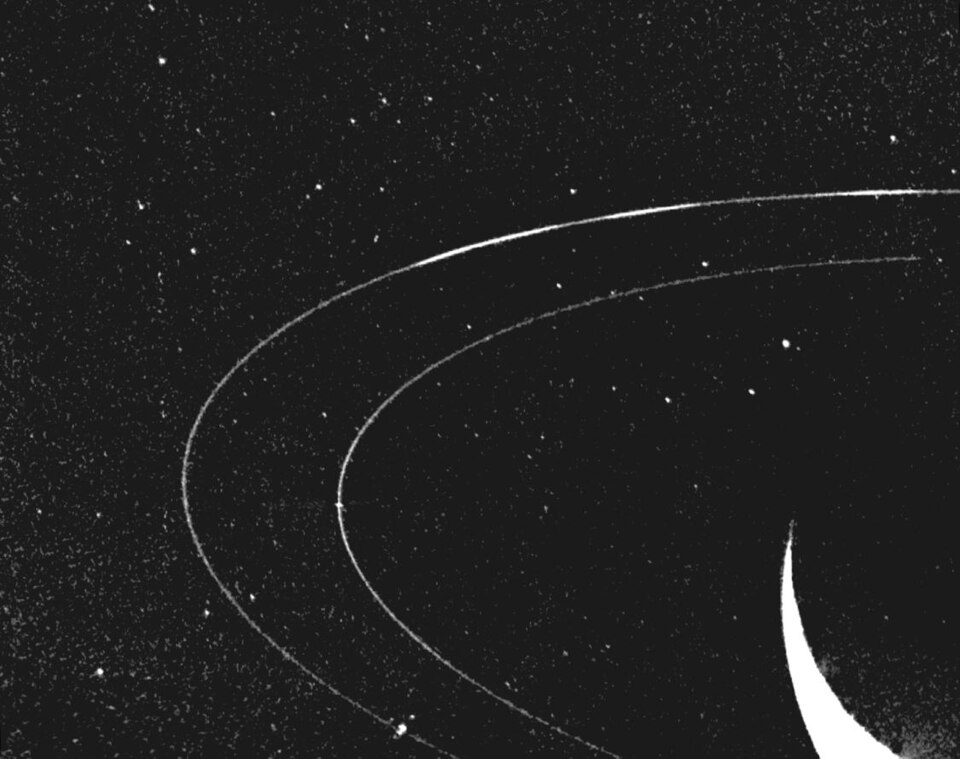
Image of Neptune’s rings taken by Voyager 2 in August 1989. Credit : NASA/Voyager 2 Team
They revealed the disappearance of the ‘Courage’ arc, followed by that of the ‘Liberté’ arc, from the 2000s onwards.
More recent data were obtained using the Keck II telescope, a 10-metre-diameter instrument situated on Mauna Kea in Hawaii. Those images were taken in the H band (1.6 micrometres) and Kp band (2.12 micrometres) on 7 and 8 October 2021.
They confirm the disappearance of Courage and Liberty, and show a weakening of the Equality arc and the continued presence of the Fraternity arc. They also show the emergence of a new structure, which now extends behind ‘Fraternité’ over a distance of around 20 degrees in longitude.
The presence of this material was confirmed on 12 July 2022 in images taken with the James Webb Space Telescope’s NIRCam in the 1.4 and 2.1 micrometre wavelengths. They show that the 2021 structure has condensed into a new arc that now follows the Fraternité arc by approximately 8 degrees.
This new arc has been named ‘Sincerity’, a name approved by the IAU Working Group on the Nomenclature of Planetary Systems in June 2024. Those observations highlight the active dynamics of Neptune’s arcs, which unfold over several decades. This activity may stem from celestial mechanics associated with resonances with one or more of Neptune’s moons.
It may be that we are observing the gradual migration of material from the leading arcs, which are disappearing in favour of the trailing arcs, with the formation of new arcs. Ultimately, these successive concentrations of material could pave the way for the formation of satellites at specific locations within the Adams Ring.
The international team responsible for these discoveries comprises D. Souami, Laboratory for Instrumentation and Research in Astrophysics (LIRA), CNRS, Paris Observatory ; I. de Pater, University of California, Berkeley ; S. Renner, the Time-Space Laboratory (LTE), Paris Observatory, and the University of Lille ; M. M. Hedman, the University of Idaho ; B. Sicardy, LTE, Paris Observatory ; and M. R. Showalter, the SETI Institute.
Link to the CBAT : http://www.cbat.eps.harvard.edu/iau/cbet/005700/CBET005759.txt