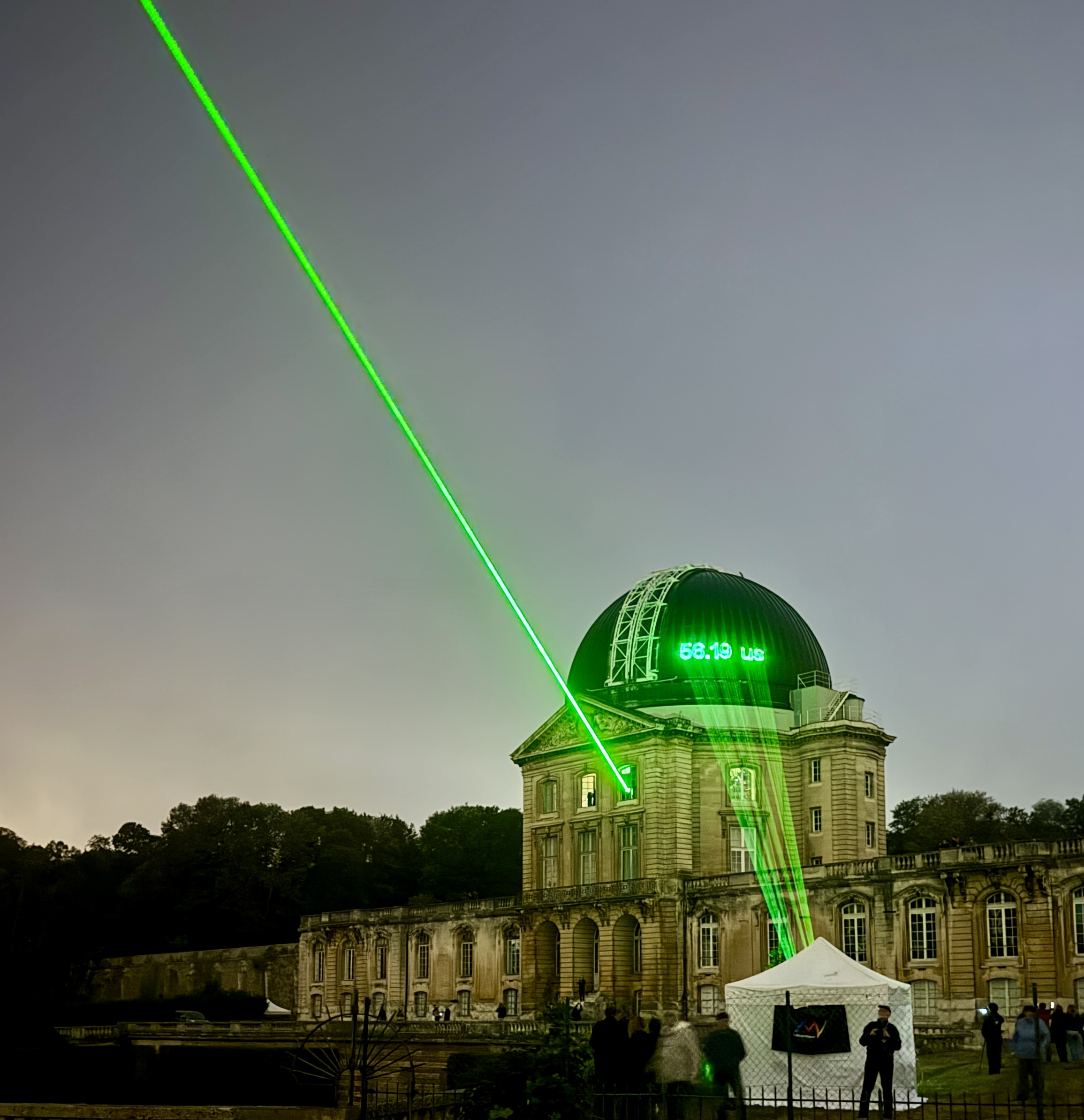
Laser beam, 9 October 2026, credit: Paris Observatory – PSL
This experiment, which was open to the public, marked several anniversaries: the 100th anniversary of the Paris and Meudon Observatories coming under a single scientific management, the 150th anniversary of the founding of the Meudon Observatory, and the 350th anniversary of the Danish astronomer Ole Rømer’s demonstration of the finite speed of light.
The contribution of the Time-Space Laboratory (LTE) was crucial to the realisation of this experiment, for which the laboratory provided a large part of the necessary equipment, such as the light source (a 10 W laser at 532 nm), the acousto-optic modulator used to generate the light pulses, and all the associated control electronics.
For several weeks, teams from the Metrology Technology Centre at the Time-Space Laboratory (LTE) have been involved in the preliminary preparation of the experiment, followed by the installation of the loaned equipment in Meudon, and the detection of the first signal following its round journey to the Arago Dome in Paris.
They are now working on measuring the time it takes for light to travel using a chronometric method, which will complement the measurements taken using the Fizeau method already in place at LIRA – Paris Observatory and UNIDIA.
This modern chronometric method is expected to improve the quality of the measurement by a factor of 100 to 1,000, compared with the historical method used by Fizeau 177 years ago.
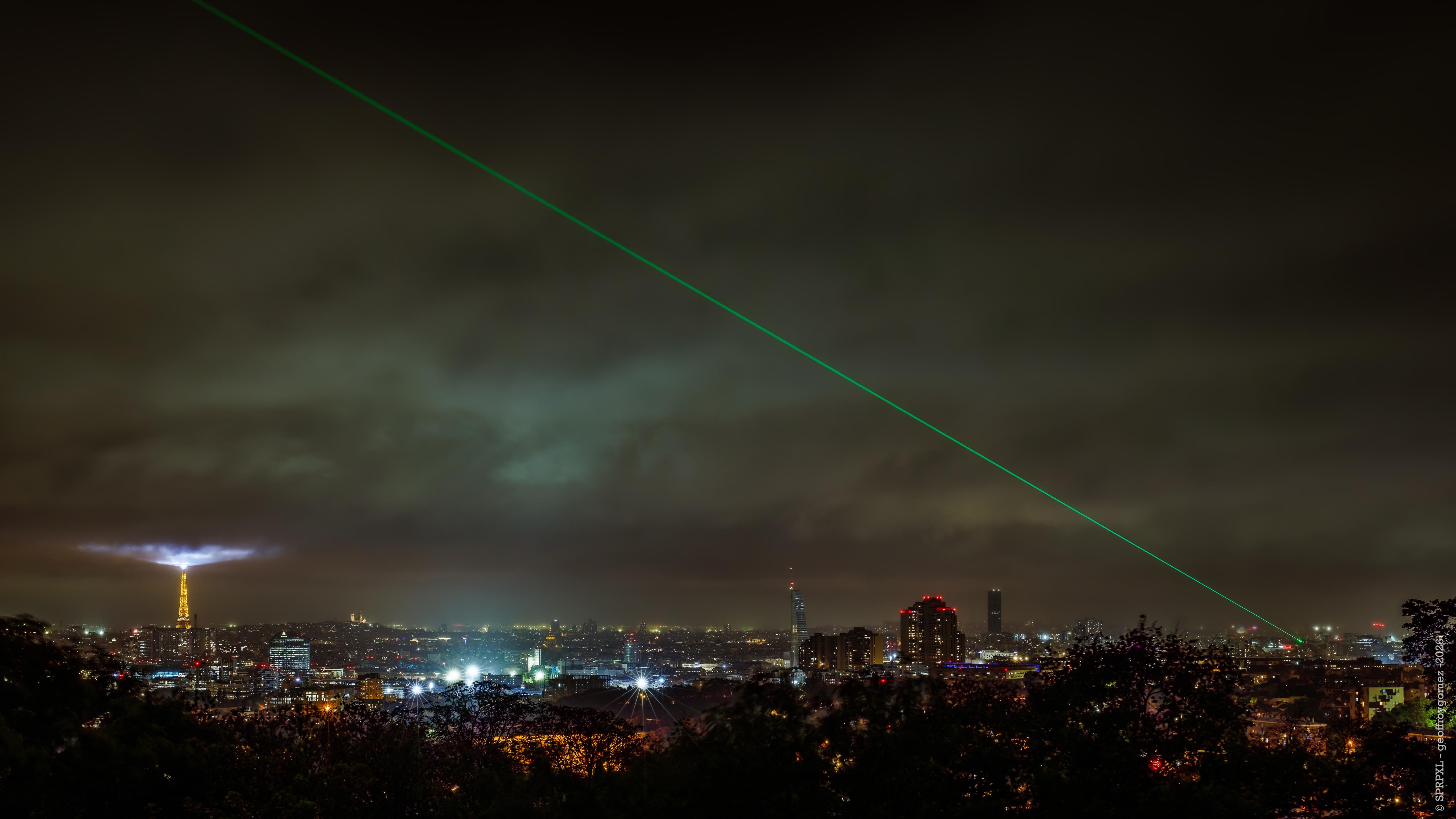
Laser beam on 9 October 2026, credit: Goeffroy Gomez
To accompany the experiment, the Observatory has designed an educational website open to the general public, pupils and teachers. It explains how a seemingly simple question – ‘How fast does light travel?’ – has transformed our understanding of the Universe, from Rømer to Einstein.
Célérité website: https://celerite.observatoiredeparis.psl.eu/