This initiative, led by NASA and ESA, has a single goal : to find a solution to the risk of a collision between Earth and a large asteroid (which is minimal but does exist) in order to prevent an event similar to the one experienced by the dinosaurs and other living species approximately 66 million years ago.
Humanity is brimming with creativity and imagination in every field, and there is no doubt that other solutions will certainly emerge in the coming years ; but for now, let’s take a look at the one currently being tested.
On September 26, 2022, NASA launched the DART spacecraft toward Dimorphos, a natural satellite of the near-Earth asteroid Didymos.
A team from the IMCCE (soon to be known as the LTE) had taken images using the 60-cm telescope (T60) at the Makes Observatory (Reunion Island) as part of the international campaign for live observation of the impact led by NASA and ESA’s Near-Earth Object Coordination Center.
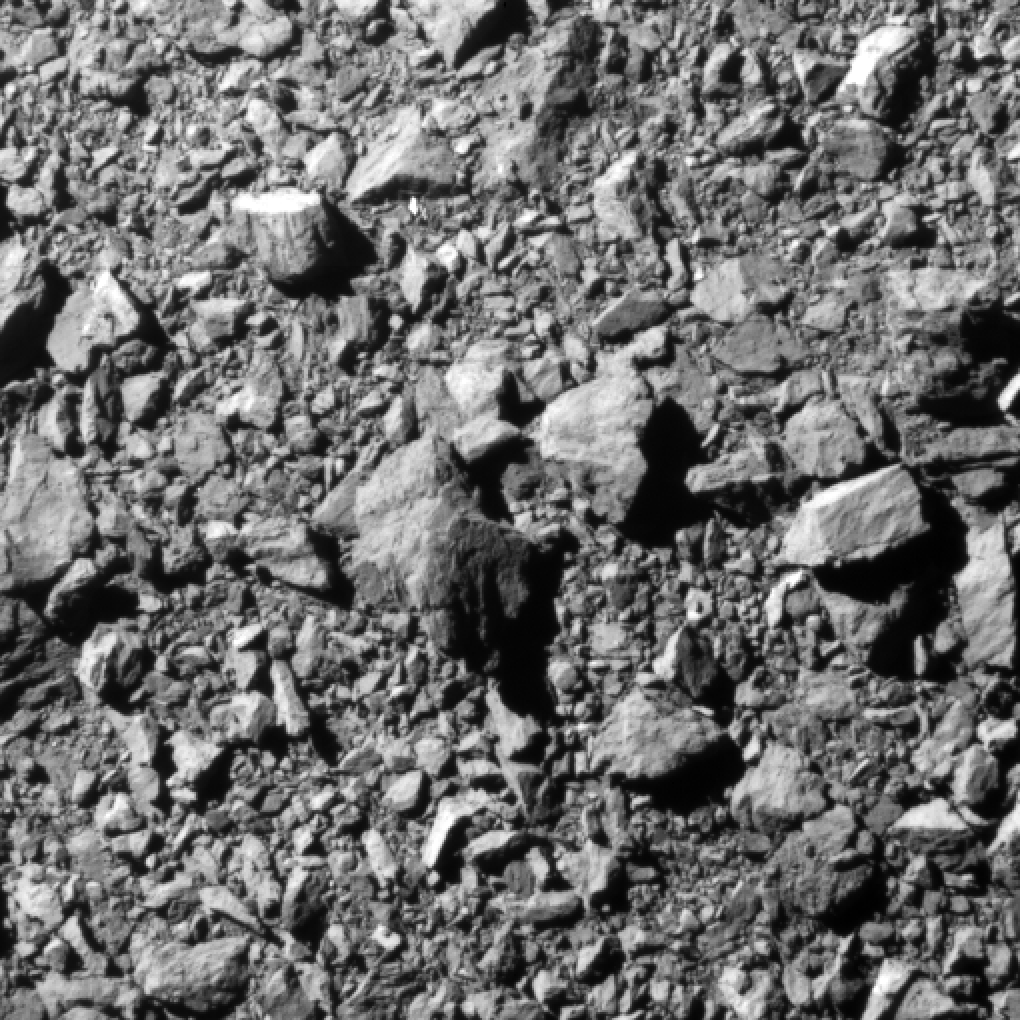
The final image sent by the DART probe of the Dimorphos satellite before impact. Crédits NASA/Johns Hopkins APL
Here is what happened next.
The images taken at the time using the T60 at the Makes Observatory had shown the impact, but these images did not reveal whether the trajectory had actually been deflected and, if so, by how much and how.
Similarly, for distant bodies, we have little information about their composition. However, an impact will not have the same effect on a very dense body as it would on a rock that crumbles to dust at the slightest touch.
To determine these effects, we needed to get closer to Dimorphos and Didymos, which are currently located about 200 million kilometers from Earth in an elliptical orbit around the Sun, passing between Mars and Earth.
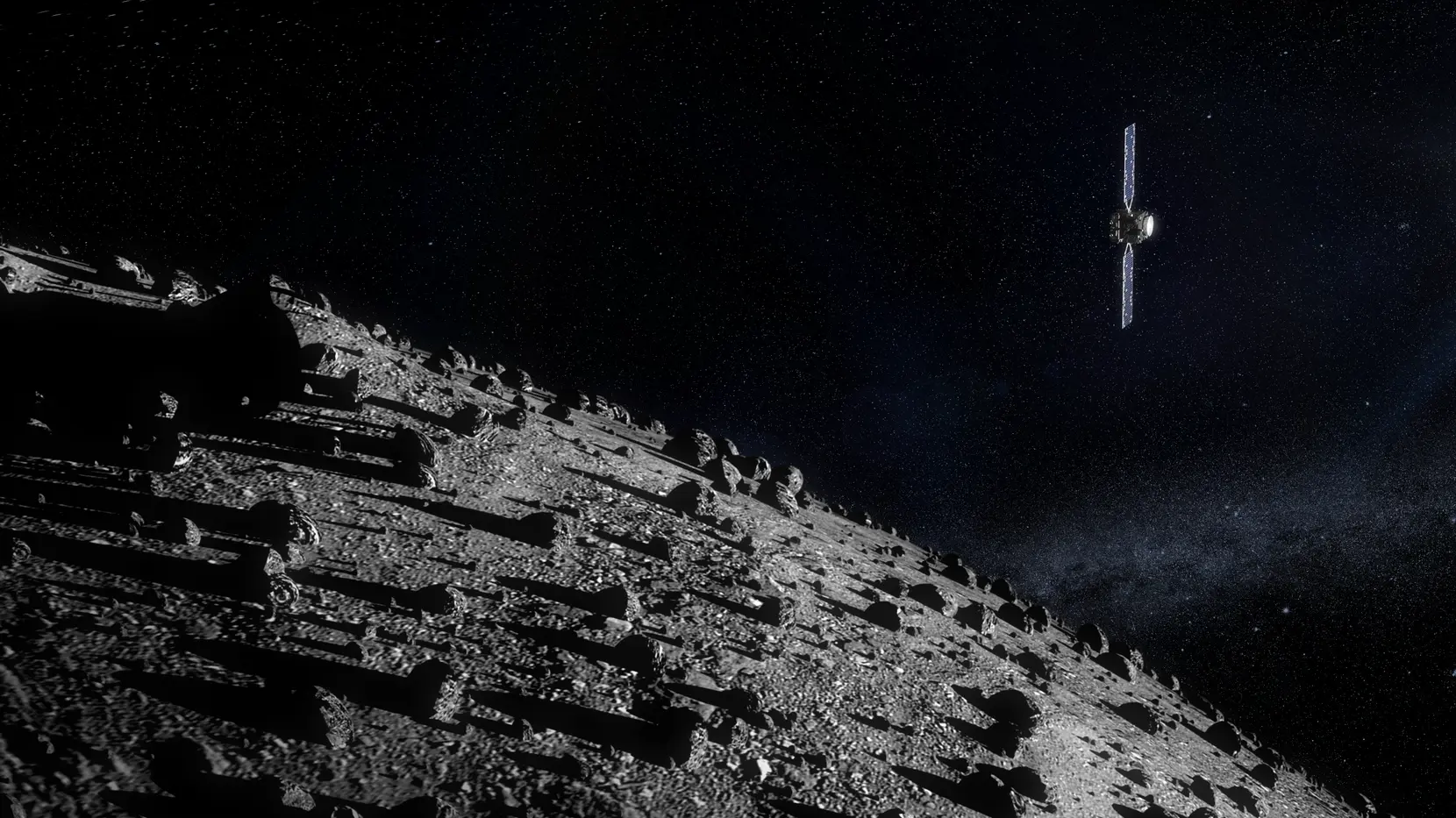
Hera approaches Dimorphos. Crédits ESA-Science Office
This is the objective of the HERA mission, which transmitted the first images of the impact crater created on Dimorphos on November 25. The scientific community involved will finally be able to attempt to answer the following questions :
- What is Dimorphos’s precise mass, and what is its structure ?
- Why was it deflected to a much greater extent than previous simulations had predicted ?
- How did the impact transform this asteroid, which is comparable in size to the Great Pyramid ?
- Does the asteroid now bear a giant crater ? Has it been thrown into an uncontrolled spin, or perhaps even completely reshaped ?
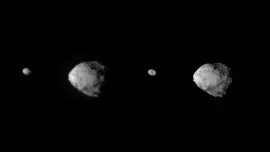
- The first images show that a substantial crater has formed on Dimorphos, but also that the ejected material is still present in the vicinity of the asteroid in the form of thousands of particles of varying sizes.
These are the initial data that scientists will now be able to analyze.
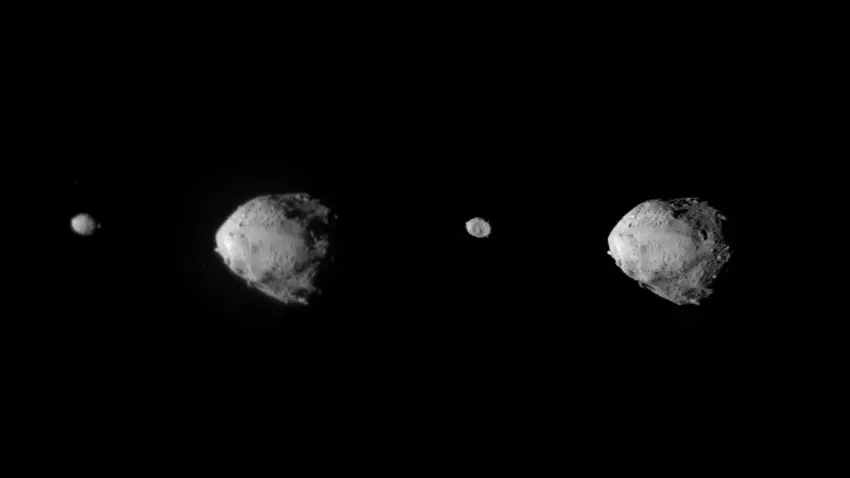
Before and after DART’s impact, from DART’s DRACO and Hera’s AFC. Crédits ESA-Science Office
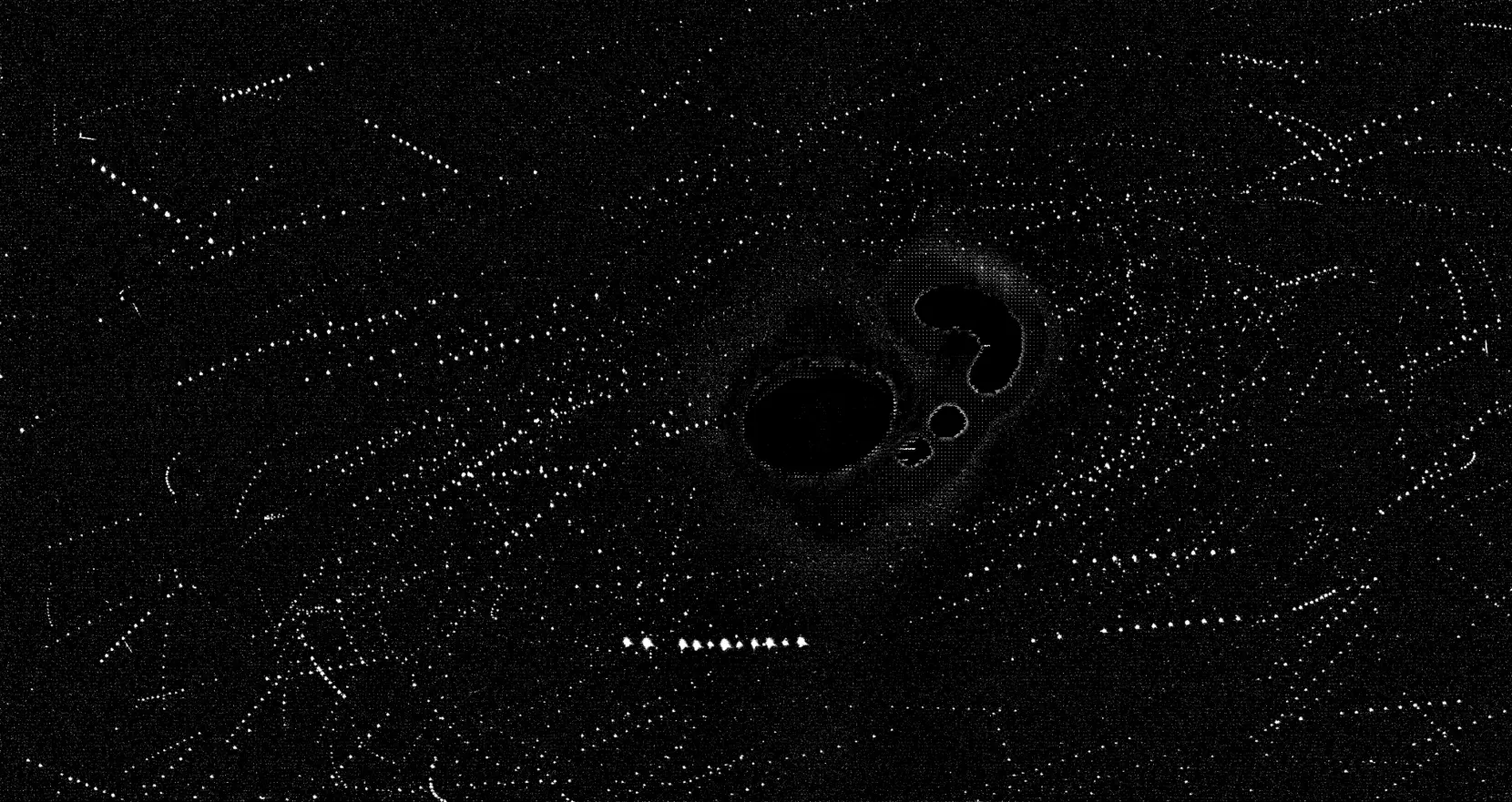
Hundreds of boulders seen in the long exposure from Hera’s Hyperscout H. Crédits ESA-Science Office
And this is just the beginning, because the mission doesn’t end there :
- January : Separation of the CubeSats and start of close-range operations for a 3- to 6-month exploration
- June : Attempted landing on Dimorphos
- September : End of the mission
The LTE is also involved in the mission, through its Arago software, to perform geometric calibration (image distortion—in this case, of stars) of the probe’s visible-light camera.
Two articles have been submitted, one of which is currently under review. Their upcoming publication will give us the opportunity to revisit the mission’s ongoing adventures and introduce you to the Arago software, which has already proven itself on other space missions.
In the meantime, feel free to follow the HERA adventure on ESA’s YouTube channel :
https://www.youtube.com/playlist?list=PLbyvawxScNbtO4aVLVx1SrsRT6yw8gahK
Watch the video of the impact in the LTE newsletter from 2022 :
https://lettre-info-lte.obspm.fr/archives/194#astro-article1
For more information on the ESA’s website (in English) :
https://www.esa.int/articles/about-us/directorates/operations/space-safety/hera/hera-reveals-stadium-sized-asteroid-crater-left-after-spacecraft-impact