
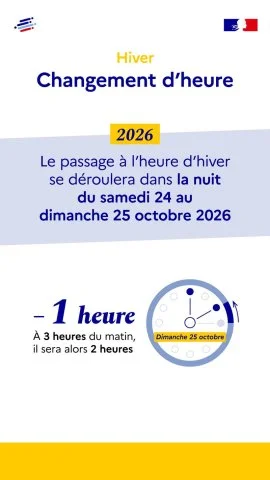
This decision is in accordance with the Order of 3 April 2001 issued by the Ministry of the Economy, Finance and Industry concerning French legal time.
The Paris Observatory is responsible for the French reference time scale UTC(OP), which is a real-time physical representation of UTC and forms the basis of French legal time.
Legal time is obtained by adding a certain number of hours to the base legal time and taking into account the switch to summer time in accordance with Decree No. 2017-292 of 6 March 2017 relating to French legal time.
The French legal time website provides the French legal time for the metropolitan departments. Several other methods of disseminating French legal time and UTC(OP) exist.
Since when have we been changing the clocks ?
1884 At the International Conference in Washington, the Greenwich Meridian was adopted as the prime meridian and the Earth’s surface was divided into 24 time zones of 15°.
1916 Daylight saving time was introduced to conserve energy resources.
1944 Daylight saving time and summer time were abolished ; a decree of 14 August 1945 set the legal time at one hour ahead of the time in its time zone (Coordinated Universal Time : UTC + 1 h).
1944 Daylight saving time and summer time were abolished ; a decree of 14 August 1945 set the legal time at one hour ahead of the time in its time zone (Coordinated Universal Time : UTC + 1 h).
1975 Daylight saving time (UTC + 2 h) was reintroduced for the year 1976 (decree of 19 September 1975) to save energy by reducing the need for artificial lighting in the evenings. This measure, which was intended to be temporary, is still in force.
1976 Greenwich Mean Time (GMT), the mean time at the prime meridian, was replaced by a new designation : Universal Time (UT), followed by various variants and, in particular, harmonisation at European level through several successive directives from the European Commission, implemented by the Member States.
September 2018 The European Commission published a proposal for a directive to the European Parliament and the Council of the European Union putting an end to seasonal time changes and repealing Directive 2000/84/EC.
On 3 April 2019, the Council of the European Union published the results of the European Parliament’s first reading of this proposal. During the plenary vote, which took place on 26 March 2019, the Parliament adopted 32 amendments to the proposed directive.
In this text, it proposes that Directive 2000/84/EC be repealed with effect from 1 April 2021 and that Member States should notify the Commission, by 1 April 2020 at the latest, of their intention to change their legal time on the last Sunday in October 2021.
However, by 1 April 2020, due to the coronavirus pandemic, no Member State had notified its decision ; it was therefore decided that the switch to summer time would not be repealed on the last Sunday in October 2021 and that the switch to winter time would be maintained.
27 April 2021 The European Commission published a directive (2021/C 149/01) extending the seasonal time change until 2026.
How is the time defined in a given location ?
Europe is covered by three time zones defined by a constant offset from UTC.
Each European country has chosen a time zone based on its longitude.
Each country also observes summer time, which means that during the summer months, there is an additional one-hour time difference compared with the chosen time zone.
To facilitate relations between countries, European Union member states switch to summer and winter time on the same day and at the same time.
Many European countries that are not members of the European Union follow the same practice ; only Iceland, Belarus and Norway (for the regions known as Svalbard and Jan Mayen) do not follow this rule.
During the summer, the abbreviations for the civil time zones become WEST, CEST and EEST respectively, with the letter ‘S’ standing for ‘Summer’.
French legal time website : https://heurelegalefrancaise.fr/
Summer time, winter time, leap seconds in UTC(OP), TAI-UTC differences : https://syrte.obspm.fr/spip/fr/services/ref-temps/article/heure-d-ete-heure-d-hiver-saut-de-seconde-dans-utc-op-differences-tai-utc.html
European Directive [2021/C 149/01] : https://eur-lex.europa.eu/legal-content/FR/TXT/?uri=CELEX:52021XC0427(01)