In recent years, rings have been discovered around small bodies in the solar system, such as Centaur-type objects like Chariklo and Chiron, or trans-Neptunian objects like Haumea and Quaoar. Unlike the giant planets, which are practically axisymmetric, these small bodies are irregular, creating strong spin-orbit resonances between the central object and its rings. In fact, several of the rings discovered are close to a 1/3 spin-orbit resonance with the body, in which the body completes three rotations whilst a particle in the rings completes one orbital revolution.
This is not the first time that resonances have been linked to the presence of confined rings. In fact, several of the rings of Saturn, Uranus and Neptune are confined by first-order m/m-1 resonances with a satellite, whereby the satellite completes m-1 revolutions whilst the particle completes m. These resonances, known as Lindblad resonances, were studied in the 1960s in the context of galactic dynamics. They force the formation of spiral arms in the disc, and in the case of rings, they can lead to the confinement of narrow rings.
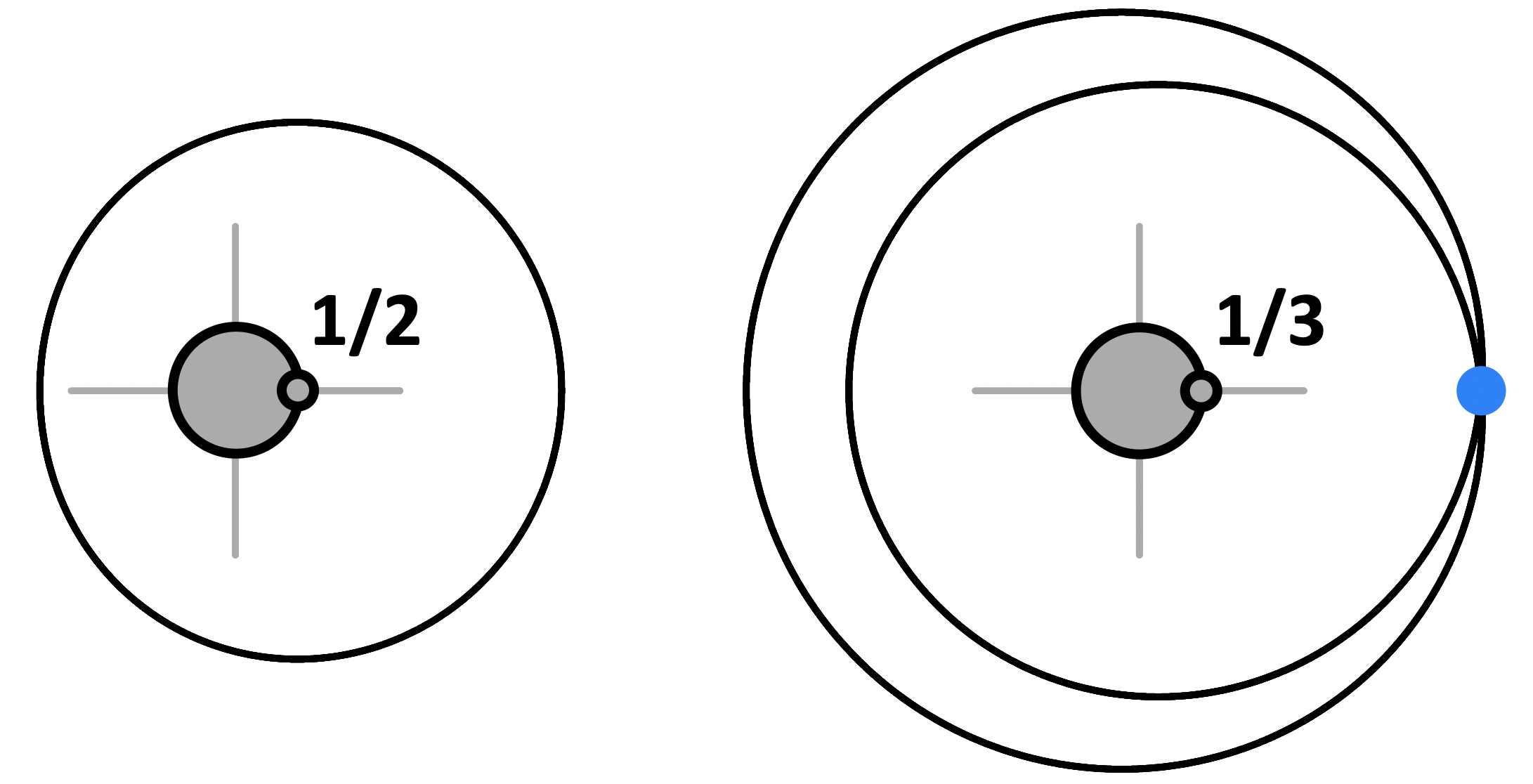
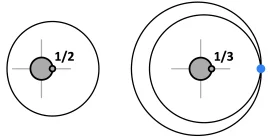
In principle, the effect of a second-order m/m+2 resonance (i.e. 1/3 for m=1) is destructive. Indeed, unlike Lindblad resonances, the 1/3 resonance causes the current lines forced by this resonance to cross, a highly dangerous situation for a collisional ring. It is as if motorways were being built that cross without traffic lights ! This is illustrated in the figure opposite, where we see the central body with a mass anomaly (small circle attached to the central body), surrounded on the left by the periodic orbit of a particle in a 1/2 spin-orbit resonance with the central body. This orbit does not intersect itself, unlike the periodic orbit corresponding to the 1/3 resonance on the right, which has a self-intersection point (blue dot).
The authors of the paper used N-body simulations, in which tens of thousands of particles with radii of a few tens of metres undergo inelastic collisions, whilst being perturbed by an irregular central body. This irregularity is modelled by a mass anomaly representing, for example, a mountain or a crater on the surface of Chariklo ; see the figure above. This mass anomaly is quantified by a dimensionless parameter µ, which measures its mass relative to that of the central body.
Following an excitation phase that leads to the self-crossing of the current line excited by the 1/3 resonance, a surprising phenomenon occurs : the ring transfers the energy it receives to free Lindblad modes, thereby eliminating the self-crossing of the orbits. Even more surprisingly, these free modes ultimately lead to the radial confinement of the ring.
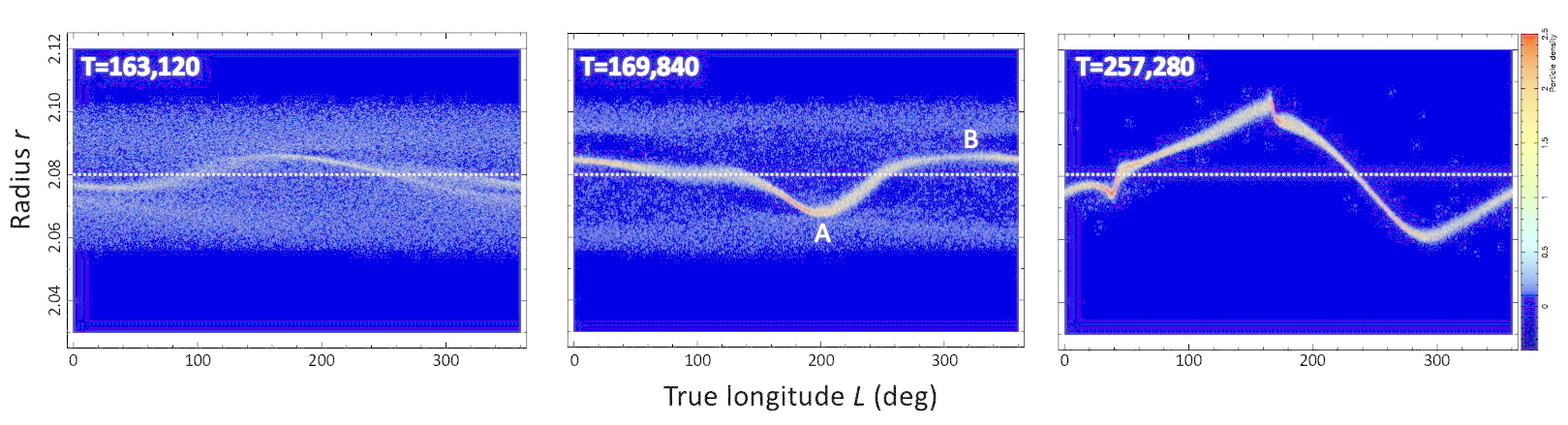
This process is illustrated in the figure above. It is the result of an N-body simulation involving 40,000 particles with a radius of 25 metres undergoing inelastic collisions and perturbed by the 1/3 resonance. The positions of the particles are shown in a longitude-radius diagram, with the dotted line indicating the radius of the 1/3 resonance. In the case of Chariklo, the radius range covered here (from 2.03 to 2.12) corresponds to a radial distance of approximately 18 km centred on the orbital radius of the resonance towards a radius of 2.08, corresponding to 400 km for Chariklo. The time shown is in units of Chariklo’s rotation period (approximately 7 hours), i.e. approximately 130, 136 and 205 years for the left, centre and right panels, respectively. On the left, we see the current line forced by the 1/3 resonance, with self-crossing, followed by a transition period in the centre panel, which leads on the right to a strongly confined ring, which now avoids any self-crossing. Fourier analysis of this ring shows that it results from the superposition of Lindblad free modes.
By varying the mass anomaly µ and the particle radius, and using dimensional analysis, the authors show that Chariklo’s main ring can be confined with mass anomalies of the order of µ≈10⁻³, assuming particles of the order of one metre in size. This value corresponds to a mountain (or crater) approximately 10 km high (or deep) on the surface of Chariklo, which is physically plausible for a small body with a diameter of approximately 250 km.
This animation shows the confinement of a ring around the 1/3 resonance with Chariklo. It is the result of an N-body simulation involving 40,000 particles with a radius of 25 metres undergoing inelastic collisions and perturbed by the 1/3 resonance with Chariklo, with Chariklo completing three rotations whilst the particles complete one orbital revolution. The ring’s arc is shown in perspective, with the distance on the x-axis (2 to 2.12) corresponding to approximately 24 km. The elapsed time in years since the start of the simulation is shown at the bottom right of the image.
This mechanism could also apply to the rings of Haumea and Quaoar, given that the latter also has a ring that is close to a 5/7 resonance with the central body. Like the 1/3 resonance, it is of order two, and therefore has the same topological structure, with self-crossings of the periodic orbits, and possibly the same behaviour as Chariklo’s ring.
Reference
The article is published under the title : "Rings around irregular bodies II. Numerical simulations of the 1/3 spin-orbit resonance confinement and applications to Chariklo" dated 26 March 2026, https://doi.org/10.1051/0004-6361/202556946.
Another article setting out the theoretical aspects of resonances, by Sicardy, Salo, El Moutamid, Renner and Souami, was published on 25 November 2025, https://doi.org/10.1051/0004-6361/202556950.
This research was partly funded by the "Roche" project of the French National Research Agency ANR-23-CE49-0012. It is the result of scientific research carried out in France, at the Paris Observatory – PSL in Laboratoire Temps et Espace (Paris Observatory – PSL / CNRS / Sorbonne University / University of Lille) and at the University of Oulu in Finland.
Contacts
Bruno Sicardy, Professor Emeritus SU, LTE
+33 (0) 1 40 51 23 34
bruno.sicardy@observatoiredeparis.psl.eu
Heikki Salo, Space Physics & Astronomy Research unit, University of Oulu
90014 Oulu, Finland
Heikki.salo@oulu.fi
