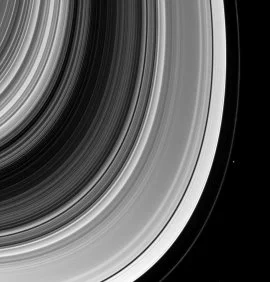
The Cassini-Huygens mission, led by NASA, ESA and the Italian Space Agency (ASI), explored Saturn, its rings and its moons between 2004 and 2017. By applying advanced computer vision techniques to data from this mission, Guillaume Tochon, lecturer-researcher and head of the Image Processing and Pattern Recognition team at the EPITA Research Laboratory, Valéry Lainey, astronomer at the LTE at the Paris Observatory, and Giulio Quaglia, PhD student at the LTE, have identified a new way of exploiting images. This improves the study of cosmic rays, facilitates the search for new moons, and opens up new perspectives for the exploration of planetary systems.
When image processing meets astronomy : a fruitful collaboration
This scientific partnership began when an EPITA student started an internship at the Paris Observatory in autumn 2020.
The astronomers then learned about the school’s team of experts in image analysis algorithms. For Guillaume Tochon, the collaboration is a unique opportunity : "The issues involved in space images lend themselves particularly well to processing by pattern recognition algorithms. "
Guillaume Tochon and his team are specialists in mathematical morphology and their work covers a broad spectrum. The application to space opens up a field that has yet to be explored by the team. The Cassini mission, which photographed the Saturnian system for 13 years, constitutes an immense source of data. Too vast for astronomers alone to handle, it includes hundreds of thousands of images, many of which have never been examined in detail.
Based on this raw material, Giulio Quaglia’s thesis aims first and foremost to answer one question : are there still unknown moons hidden in these images ?
Artificial intelligence to distinguish the invisible
Detecting tiny celestial objects is like identifying ‘spots measuring just a few pixels in these images,’ says Guillaume. The difficulty lies as much in their small size as in their diversity, including stars, known or potential moons, and cosmic rays striking Cassini’s sensor. These high-energy particles leave short, irregular traces that are impossible to annotate manually on thousands of images.
The team therefore created an initial semi-automatic database, a naive algorithm that identifies all bright sources and then classifies them according to their correspondence with star catalogues or moon ephemerides. Anything that does not correspond to anything already known is categorised as cosmic radiation. Despite its imperfections, this database is used to train a neural network. ‘Our bet is that it is statistically good enough,’ explains Guillaume Tochon.
And this bet paid off : the AI learned to correct the initial errors. For example, when the naive algorithm confused thin portions of rings with particles, ‘the network was not fooled’.
On several dozen images annotated manually for validation, the model shows a remarkable ability to distinguish between the three categories of objects.
Above all, the results obtained on cosmic rays are striking. The spatial and temporal distribution deduced from the images is consistent with the measurements obtained by the specialised instruments on board the Cassini probe. ‘We were able to obtain similar results (...) just with a camera,’ the researcher points out.
From Saturn to Jupiter : a methodology destined to travel
This breakthrough opens up several concrete possibilities. First, the search for new moons : all predictions generated by AI have been stored and can be cross-referenced with orbital models.
Second, this work directly paves the way for the JUICE (Jupiter Icy Moons Explorer) mission, a European Space Agency space mission dedicated to studying Jupiter and its major icy moons. ‘What we have developed here for Saturn will be directly transposed’ to future images from the probe. The ability to analyse high-energy particles using simple cameras could significantly reduce the cost of space missions, where each additional instrument represents a technical and financial challenge.
This collaboration with the Paris Observatory illustrates EPITA’s mission : to bring decisive scientific and technological expertise to other disciplines. As Guillaume Tochon points out, ‘the goal is not necessarily to innovate in methods, but to correctly transfer the methods we have mastered.’
The image thus becomes a common language between engineers and astronomers, capable of revealing what the human eye cannot detect.
Learn more
Juice, Europe’s next major scientific mission.
Crédits image : NASA/JPL-Caltech/Space Science Institute
